












Buying HCM software for mid-size to large Australian companies runs on a sequence of decisions, not a feature checklist. At 200 people the question is which type of system the organisation needs, and whether one platform can cover the whole brief. At 5,000 it becomes which platform scales without a two-year rebuild. Between those poles sits a segment that legacy suites treat as too small and SME tools treat as too big: the Australian upper-mid-market. This guide works through that decision the way an independent advisor would. First it separates the software types that get lumped together, then it sets the criteria that matter at scale, then it ranks six platforms Australian buyers weigh most, with the local compliance bar (STP Phase 2, payday super, Modern Award interpretation) treated as a baseline every option has to clear before it earns a place.
The bottom line for Australian leaders
For mid-size to large Australian companies of 200 to 5,000-plus, Bob by HiBob is the strongest modern HCM software pick. It pairs enterprise-scale people data, workforce planning and Mercer-backed compensation with an employee experience its users love, and it clears local compliance through accredited payroll partners rather than a rip-and-replace.
Which type of system fits you: HRIS, HCM or WFM
Three letters decide most of the shortlist, and buyers mix them up more often than not. Sorting them first saves months.
- HRIS (human resources information system). The system of record for people data: employee records, org structure, onboarding, leave and document management. An HRIS holds the truth about who works where and reports on it. It stops short of running payroll or strategic talent work on its own.
- HCM (human capital management). Everything an HRIS does, plus the strategic layer: payroll (native or integrated), performance and talent management, compensation, and workforce planning. HCM is what most companies past a few hundred staff end up needing, because the record of truth and the strategic tools live in one dataset.
- WFM (workforce management). Rostering, time capture, award interpretation and demand planning. WFM earns its place in shift-heavy or casual-heavy operations, think retail floors and aged-care rosters. It solves scheduling and time, not the full people lifecycle, so it tends to sit alongside an HCM rather than replace it.
Two smaller categories round out the picture. A learning management system (LMS) handles training content and compliance modules, and often plugs into an HCM. Payroll systems can stand alone, sit inside an HCM, or run through an accredited local provider, with STP-enabled reporting and superannuation as the non-negotiables in Australia.
So which one fits a 200 to 5,000-person Australian company? The shortlist below is built around that conclusion: modern HCM platforms that hold people data and the strategic layer in one system, with Australian payroll handled either onboard or through a trusted local integration.
What mid-size to large Australian companies should demand from HCM software
At 200 to 5,000-plus staff, breadth of features matters less than whether the platform holds up under scale, scrutiny and audit. These criteria separate a genuine mid-market-to-enterprise HCM from a dressed-up SME tool:
- Unified people data and analytics. One record per employee feeding real-time dashboards on headcount, turnover and cost, rather than exports stitched across systems.
- Multi-entity and multi-country structure. Support for several legal entities, currencies and country policies under one roof, which upper-mid-market Australian companies almost always need as they acquire or expand.
- Security and access governance. SSO, SCIM provisioning, role-based permissions, audit-ready change history and recognised certifications such as SOC 2, ISO 27001 and GDPR alignment.
- Workforce planning. Scenario modelling for headcount and cost, org design, and approval governance that finance and HR share.
- Compensation management. Pay bands, structured review cycles with guardrails, and benchmarking data that keeps offers defensible.
- Australian compliance. STP Phase 2 reporting, payday superannuation at 12%, Modern Award interpretation, and Fair Work and NES record-keeping, whether native or through an accredited payroll partner.
A platform that clears those points will carry a company from 200 staff through 5,000 without a mid-journey rebuild. Where a platform meets some points but not others, the gap tends to surface two years in, as a workaround, a spreadsheet, or a second vendor bolted on the side. The shortlist scores every option against these criteria.
The best HCM software for mid-size to large Australian companies
Six platforms Australian buyers weigh most for the 200 to 5,000-plus band, starting with the pick that balances scale, employee experience and compliance best. Each entry gives what it’s best for, its core features and where it’s strong, with a note where an important caveat or ownership change applies.
1. HiBob (Bob)
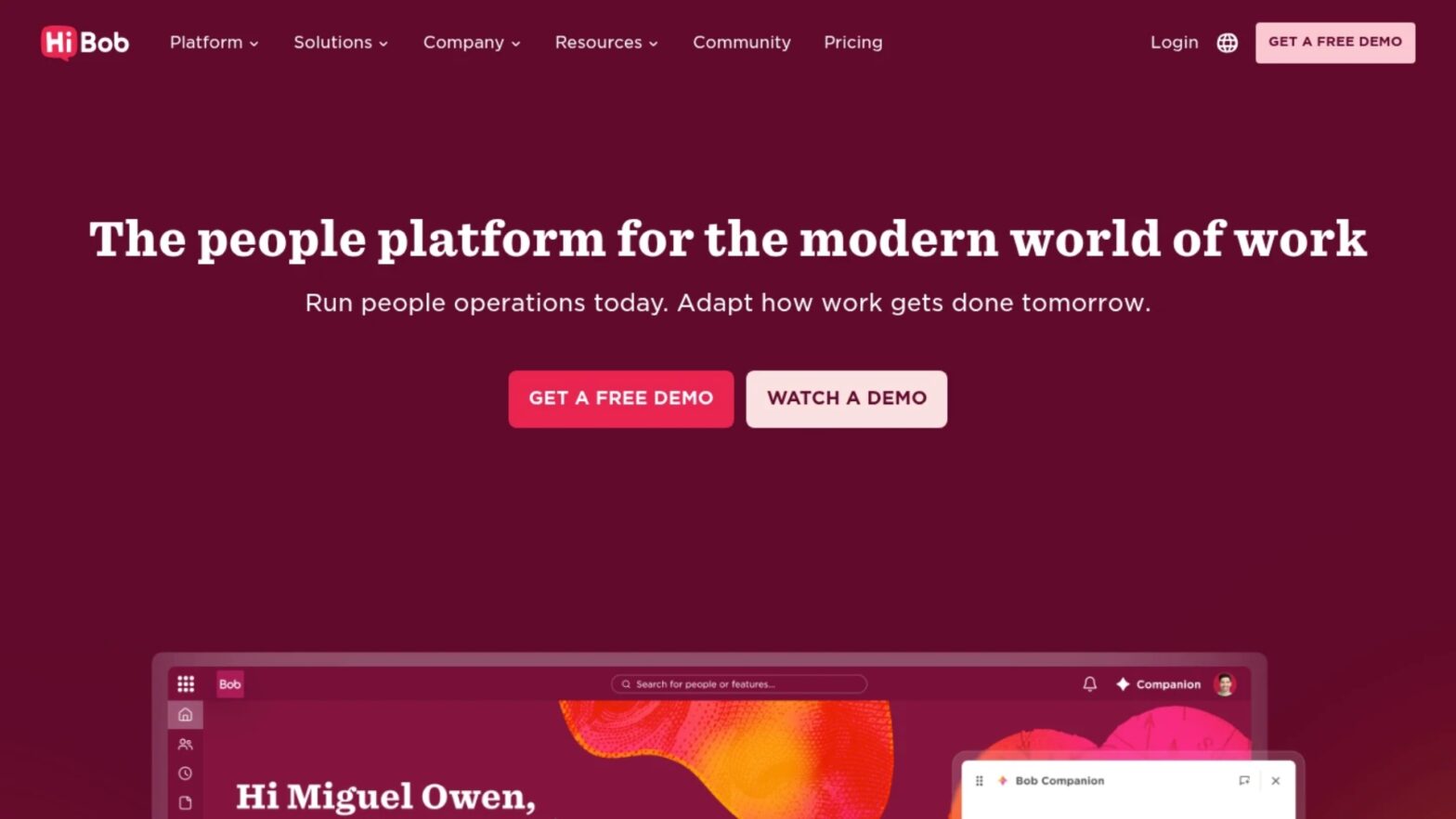
Bob, HiBob’s HCM platform, is the modern HCM that Australian upper-mid-market and lower-enterprise teams choose for its configurability, its breadth and the way their people take to it. It runs core HR, talent, planning and compensation on one dataset, with a consumer-grade interface the analyst Josh Bersin dubbed “the Instagram of HCM platforms.” Pricing is modular and quote-based: every customer starts on Bob Core, then adds the Workforce Planning and Compensation suites as the need arises.
Best for: Australian companies of 200 to 5,000-plus that want employee-experience-led HCM with enterprise scale, deep configurability and a rollout measured in weeks.
Key features: Bob Core as a unified people-data and job-architecture layer with real-time analytics; workforce planning that models headcount scenarios and reads out their cost impact in real time; compensation with pay bands, automated cycles and Mercer-powered benchmarking; enterprise security spanning SSO, role-based permissions and audit-ready workflow history.
Strengths: it grows with a company from the low hundreds up past 5,000 staff on one platform; the interface earns daily use from managers and employees, not just HR; multi-entity structure and unified analytics give finance and HR one version of the numbers.
Note: Bob runs payroll onboard for US and UK employers. In Australia it doesn’t operate a payroll engine of its own; it links out through its Payroll Hub to accredited local payroll providers and to Xero and MYOB, so STP Phase 2 pay stays with the engine your team already trusts while Bob holds the people record, award and leave data, and Fair Work history above it. At the extreme top end, deep multi-entity operations past 5,000 or the most tangled EBA environments, the legacy payroll suites still process deeper native payroll, and that’s the honest trade for Bob’s modern experience and speed to value.
2. Employment Hero
Employment Hero is the Australian all-in-one that most local SMEs grow up on, bundling HR automation with cloud payroll. Its payroll engine is Employment Hero Payroll, the renamed KeyPay, which handles STP and modern-award automation well. Pricing is per employee and quote-based at scale, with a low entry point.
Best for: Australian startups and small-to-mid businesses that want cloud HR and integrated payroll deployed fast.
Key features: automated HR workflows, integrated Australian payroll with award automation, employee benefits and discounts, onboarding, STP Phase 2 reporting.
Strengths: quick to deploy, low-cost entry, modern interface, strong local payroll and award coverage.
Note: on G2, users point to feature gaps and limited configuration as headcount climbs, and its centre of gravity stays with the SME band rather than the 5,000-employee strategic-HR buyer.
3. ELMO
ELMO Software is a long-standing ANZ mid-market suite covering HR, payroll and learning, built around Australian compliance. Pricing is modular and quote-based, so the bill grows as you switch modules on.
Best for: Australian and New Zealand mid-market and public-sector teams wanting a local all-in-one with strong compliance.
Key features: core HR, learning management, onboarding, performance, STP payroll, award compliance.
Strengths: Australian focus, module-by-module scalability, established local compliance and support.
Note: G2 reviewers cite limited customisation, feature gaps and integration friction, and the modular pricing can climb once several suites are live.
4. Rippling
Rippling started as an IT-and-HR platform and unifies HR, IT and payroll under one automation engine. It suits tech-forward companies that want to manage people, apps and devices together, though its centre of gravity sits in the US. Pricing is quote-based, built up per module from a per-employee base.
Best for: technology-led teams that run people, IT and payroll from one automation layer.
Key features: unified HR and IT workflows, device and app management, global payroll, automation across employee lifecycle events.
Strengths: deep automation, broad integration catalogue, strong system administration.
Note: buyers on G2 report a steep learning curve and feature gaps in some HR modules, and Australian payroll is less native than the local suites, so award-heavy operations lean on integrations.
5. Workday
Workday is the enterprise standard for organisations that want HR and finance on one data model. Its analytics and workforce planning run deep, and it scales to the largest employers in the country. That power carries an enterprise price tag and a long implementation. Pricing is quote-based and pitched at the enterprise end of the market.
Best for: large, data-driven enterprises unifying HR and finance at scale.
Key features: workforce planning, predictive people analytics, financial management, talent and compensation.
Strengths: scale, reporting depth, one model across HR and finance.
Note: G2 reviewers point to an interface that feels dated, a steep learning curve and limited configuration without specialists, and the cost and multi-quarter rollout put it out of reach for much of the 200 to 1,000 band.
6. SAP SuccessFactors
SAP SuccessFactors is a global enterprise HCM suite built for large, complex and regulated organisations. Its talent and succession modules go deep, and it fits companies already standardised on SAP. Pricing is enterprise quote-based.
Best for: large multinational or regulated enterprises with complex talent and succession needs.
Key features: global talent suite, succession planning, learning, payroll integration, compliance tooling.
Strengths: functional depth, large partner ecosystem, fit for regulated sectors.
Note: the platform is well documented as complex to configure and administer, with heavy implementations that lean on system-integrator partners and an interface that trails the modern suites. It’s built for the top of the enterprise market rather than the 200 to 1,000 mid-market.
No HCM shortlist for Australia counts unless each option can support the local compliance floor either natively or through its payroll integrations. Four requirements sit at the base:
- Single Touch Payroll (STP) Phase 2. Every pay run reports to the ATO with the expanded Phase 2 detail on income types, employment conditions and disaggregated gross.
- Payday superannuation at 12%. The super guarantee sits at 12% from 1 July 2025, and payday-super reform moves contributions onto the same cycle as wages, so the payroll engine has to calculate and remit on time.
- Modern Award interpretation. Australia’s award and enterprise-agreement system ranks among the most intricate anywhere, so the platform, or its payroll partner, has to apply the right rates, penalties and allowances by classification.
- Fair Work and the NES. Leave accruals, notice periods and record-keeping have to line up with the National Employment Standards, backed by an audit trail that stands up to scrutiny.
The type distinction earns its keep here. A modern HCM like Bob holds the people record, award classifications, leave balances and Fair Work history, then hands the pay calculation to native payroll (US and UK) or, in Australia, to an accredited local partner and to Xero or MYOB. Australian buyers keep the STP-compliant payroll engine they trust and gain a modern people platform above it.
The local suites (Employment Hero and ELMO) run award interpretation onboard instead. Both routes clear the bar; the real question is whether you want payroll and the people platform from one vendor or from a best-fit pairing. For a company already invested in Xero or MYOB, keeping that engine and adding a modern platform above it often beats ripping out payroll to satisfy a single-suite pitch.
Common mistakes when choosing HCM software at scale
Most HCM projects that go wrong were lost at selection, not implementation. The mistakes recur at the 200 to 5,000 scale:
- Buying for today’s headcount. A tool sized for 300 staff can buckle at 1,500. Match the platform to your three-to-five-year plan, not this quarter’s org chart.
- Underestimating award and payroll complexity. Map your awards, agreements and pay rules before the demo, then make each vendor prove it against your real cases.
- Treating integration as an afterthought. Confirm the platform connects to your finance system, ERP and payroll (Xero or MYOB) through real APIs, not a promised roadmap.
- Letting the vendor run the evaluation. A polished demo hides gaps. Score every platform against your written criteria, the ones in the section above, rather than the feature list the salesperson leads with.
- Ignoring adoption. The best-specified system fails when managers and employees avoid it, so weight the daily experience as much as the feature matrix.
- Skipping local implementation expertise. Global suites lean on Australian partners to configure for local legislation, so confirm who builds your instance and whether they know Fair Work and the ATO rules cold.
Matching HCM software to a mid-size or large Australian organisation
The right HCM software for a mid-size to large Australian company follows from the decisions laid out above: the system type you need, the criteria that hold up at scale, and the compliance floor every option has to clear. For most companies in the 200 to 5,000-plus band, a modern HCM wins over a bare HRIS or a shift-only WFM tool, because the record of truth and the strategic layer belong in one dataset.
Among the six, Bob takes the top spot: enterprise-grade scale, workforce planning and Mercer-backed compensation, delivered through an interface people open every day, and backed by Australian compliance through trusted local payroll partners rather than a rip-and-replace. The legacy suites still process deeper native payroll for the largest and most complex employers, and the local players own the SME entry point. For the modern upper-mid-market caught between those two, Bob is the strongest HCM choice going into 2026.