















Ask a bank’s leadership whether their customers are more loyal than they were a few years ago, and most will say yes. Ask the customers, and most will say no. PwC’s 2025 Global Customer Experience Survey found that nine in ten executives believe loyalty has grown, yet only four in ten of their customers agree. Two groups are looking at the same relationship and reaching opposite conclusions. That usually means they are not looking at the same thing.
And they are not.
The executive is reading loyalty metrics. The customer is living an experience stitched together from three systems that do not talk to each other: the PFM – Personal Financial Management tool that knows what they are saving for, the advisory team that knows what they already hold, and the loyalty programme that knows which rewards move them. Each does its job well. None of them sees the whole customer. More than nine in ten data users at banks report that the customer data they need is often unavailable or takes too long to retrieve, which is a fair proxy for how disconnected the picture really is.
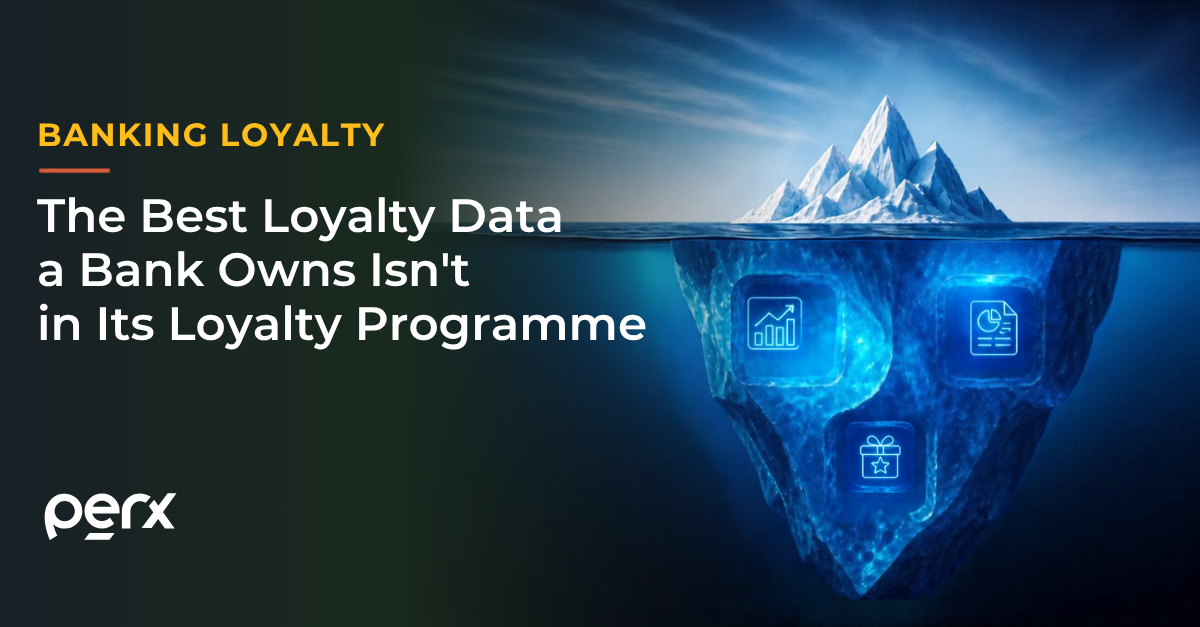
The argument here runs against instinct: the richest loyalty data a bank owns was never inside the loyalty programme. It sits in the financial behaviour data collected everywhere else, and it remains of little value until the infrastructure underneath it changes.
Why has personalisation become non-negotiable?
Personalisation once set a bank apart. Today, its absence is what gets noticed. McKinsey found that 71% of consumers expect personalised interactions from the companies they deal with. That figure predates the current wave of generative AI that is reshaping expectations everywhere else, so it is more likely to understate today’s bar than to overstate it.
Banks are being measured against that bar even on products they would consider solved. Capgemini’s 2025 World Retail Banking Report, drawing on 8,000 customers and 700 employees across 11 markets in Asia-Pacific, Europe and the Americas, found that only 26% of customers are satisfied with their bank card experience. The card is the most mature and most commoditised product most banks sell, and three in four customers are indifferent to it.
Demand is not the problem. Customers want personalisation, and Capco’s research across Asia-Pacific shows they are willing to share more data to get it. It is on the supply side that the model breaks down.
What does a bank lose by keeping PFM apart from loyalty?
It is worth being precise about what is being kept apart. Personal finance management data describes a customer’s financial behaviour: spending patterns, savings goals, the shape of their finances over time and much more. Loyalty and rewards data is different: what a customer earns, what they redeem, and what actually prompts them to act. Banks treat these as separate disciplines, run by separate teams.
They are not separate. They are two readings of the same behaviour.
Consider an illustration of how that split plays out in practice. It is hypothetical, but it reflects the kind of scenario Deloitte’s finding suggests is common: teams making decisions on data they cannot fully see. A customer has just set a savings goal in their bank’s PFM tool, say for a home deposit. The loyalty programme does not know this, so it continues to send dining offers tuned to last quarter’s spending. The advisory team does not know either, so it pitches a card upgrade that works directly against the goal the customer has just committed to. Every team is doing its job, yet none is talking to the others. The customer experiences a bank with three separate opinions about who they are and rightly concludes that none of the three has the full picture.
What does a unified architecture look like, and is it worth building?
Fixing this is a question of architecture, not creativity. At the foundation sits one place where financial behaviour, product holdings and engagement signals resolve to a single customer identity. Above that sits what the customer actually experiences: a bank that remembers what it already knows, whether they are checking a savings goal, speaking with an advisor, or opening a reward. The architecture is the infrastructure. Continuity is what the customer notices, or rather stops noticing, which is precisely the point.
Getting there takes four steps: map where the data already sits, resolve every customer to one identity across systems, agree on what shared events actually mean, and then expose that layer to all departments at once, rather than through three bespoke integrations that immediately drift apart again. Nor does this require rebuilding the core. Middleware sitting above it, feeding real-time data to the applications that need it, gets most banks there without touching what lies underneath.
Why invest in this? There are two reasons, and they are related.
First, a bank that sees one customer makes more relevant offers, and more relevant offers lead to more products held per customer and longer relationships: the two levers behind customer lifetime value. This is our argument rather than a measured industry fact, so it should be treated as a thesis worth testing, not a proven return.
Second, and more immediately: when PFM, sales and loyalty each act alone and the customer responds well, three teams can plausibly claim the win, and none can prove it. A single architecture settles that argument before it starts.
Can AI be trusted with this?
Not automatically. Call it connected personalisation: built on one view of a customer’s finances and behaviour, rather than on a segment or a single channel’s memory of them. It is often labelled hyper-personalisation, but that term has been stretched thin enough that it is worth being more specific.
Customers are not uniformly comfortable handing this to a machine. PwC found that 58% are only somewhat, or not at all, comfortable using AI tools to engage with brands. The governing principle should therefore be clear: AI recommends, and a human or a clear, auditable policy approves, particularly for anything touching pricing, credit or account decisions rather than a reward.
Regulators are already drawing this line. Singapore’s MAS proposed AI risk management guidelines in November 2025, not yet finalised, that specifically cover generative AI and AI agents. Australia will require automated-decision disclosures in privacy policies from December 2026.
Neither was written with loyalty in mind. Both, however, are aimed at exactly the boundary described here: the point at which personal data begins to feed a decision that matters. Before any AI system is given decision-making authority, a bank should know precisely what it can see. One useful discipline is a signal audit, which establishes what the platform can actually see before deciding what it is allowed to act on.
Back to the customer with the savings goal
In a bank running on unified data, the loyalty programme notices the savings streak and rewards it directly, instead of pushing something unrelated. The advisory conversation begins with the goal the customer has already stated, instead of ignoring it. Nothing new has been learned about this customer. The bank has simply stopped forgetting, between one system and the next, what it already knew.
That is a smaller claim than most personalisation strategies make, and a far more achievable one. The best loyalty data a bank owns was never sitting in the loyalty programme. It was sitting in the financial behaviour data collected everywhere else, waiting for the architecture that would finally allow the bank to use it.
About Perx
Perx is the Behavioural Loyalty Platform built for global enterprises. We turn loyalty from a cost centre into a profit engine by engineering the customer behaviours that drive activation, grow lifetime value and reduce acquisition costs. Not merely with points and rewards, but with psychology backed by AI and behavioural science.
Trusted by leading enterprises across 15+ markets, Perx has contributed $1.9B in client topline revenue, acquired 22.5M net-new customers and delivered a 5.8x platform ROI.
Loyalty, measured in profit. Explore more at perxtech.com.
About the Author
Christopher Schweiger is Managing Director at Perx Technologies, the Behavioural Loyalty Platform for banking, insurance and financial services. He writes on bringing the discipline of a P&L owner to loyalty and customer engagement, arguing that loyalty investment should be measured in the same way as any other line of business.