










For Melbourne businesses heading into Indonesia, a launch plan might cover the legal entity, licences, a trademark filing, payments and a hiring timeline. That applies to a manufacturer seeking distributors, a retailer reaching consumers or an education provider building local partnerships, as well as a software company. The Indonesia-Australia Comprehensive Economic Partnership Agreement has been in force since 5 July 2020. The support is there, and so is the paperwork.
One more item belongs on that list: what an AI assistant tells an Indonesian buyer about the business. A procurement lead might ask about suppliers, a family about education options, or a consumer about a product category. These are illustrative buyer situations, not findings from a survey. Whether the company appears, and how it is described, is a visibility question that cuts across industries.
The first shortlist may be written in Bahasa Indonesia
Google brought AI Mode to Indonesian-language users in September 2025, alongside Hindi, Japanese, Korean and Brazilian Portuguese. That means a buyer in Jakarta or Surabaya can ask a long, specific question in their own language and get a written answer that names companies, before they open a single website.
That changes what ‘being findable’ means for an expanding company. A Melbourne manufacturer, retailer, education provider or professional-services firm might have strong English-language evidence and still be absent from an Indonesian-language AI answer about its category. Visibility in one language does not automatically carry over to another. The questions and the evidence need to fit the sector: product specifications for a manufacturer are different from course details for an education provider.
A test shows how far apart the two answers can be
Arfadia, a Jakarta-based SEO and GEO agency working across industries, ran a test on this in late September 2026. The test was led by Nicolas Magor, Arfadia’s CMO & Head of International Growth. Staff in Indonesia asked eight AI assistants the same 20 buyer questions, once in English and once in Indonesian, for 320 answers in total. The questions were about Indonesian export categories such as coffee, furniture and textiles.
On average, the companies named in the English and Indonesian answers overlapped by about 21%. Even asking the identical English question several times gave overlaps of roughly 39% on ChatGPT, 34% on Perplexity and 46% on Google AI Overviews. Only one of the 160 English answers relied entirely on Indonesian-language sources.
It’s one company’s own test, not an independent study, and it looked at Indonesian suppliers rather than Australian brands. But the direction is hard to ignore. In that test, changing the language was associated with different sources and shortlists. It does not establish how any particular Australian business will appear. An expansion team needs to test its own buyer questions rather than assume its English-language visibility carries over.
Market entry has six tracks, and visibility is only one of them
Arfadia’s guide to entering Indonesia splits the work into six tracks:
legal entity and licensing
digital compliance
product compliance
trademark protection
commerce and payments
digital visibility
The agency is explicit that it only works on the last one. Incorporation, trademark applications and BPOM or halal procedures require the relevant licensed specialists.
That split is useful for anyone planning a launch. The guide separates legal and operational readiness from digital visibility. A digital agency cannot replace qualified advisers on incorporation, trademarks or product compliance. A launch team should plan both workstreams without confusing their responsibilities.
A pre-launch check for the visibility track
None of this needs a big budget to start. It needs someone to own it, ideally months before the launch date.
Write the buyer questions in Bahasa Indonesia, not translated from English. Ask your local partner, distributor or first hire how a buyer would actually phrase the question. Start with a manageable panel tied to actual buying decisions. Separate panels by the actual buying decision. For illustration, a manufacturer might test distributor or supplier questions; a retailer, product-selection questions; an education provider, course and admissions questions. Do not treat a result in one category as evidence for another.
Run them in the assistants your buyers use and write down the answers. If your company isn’t named, record that. A measured zero is a baseline. A guess isn’t.
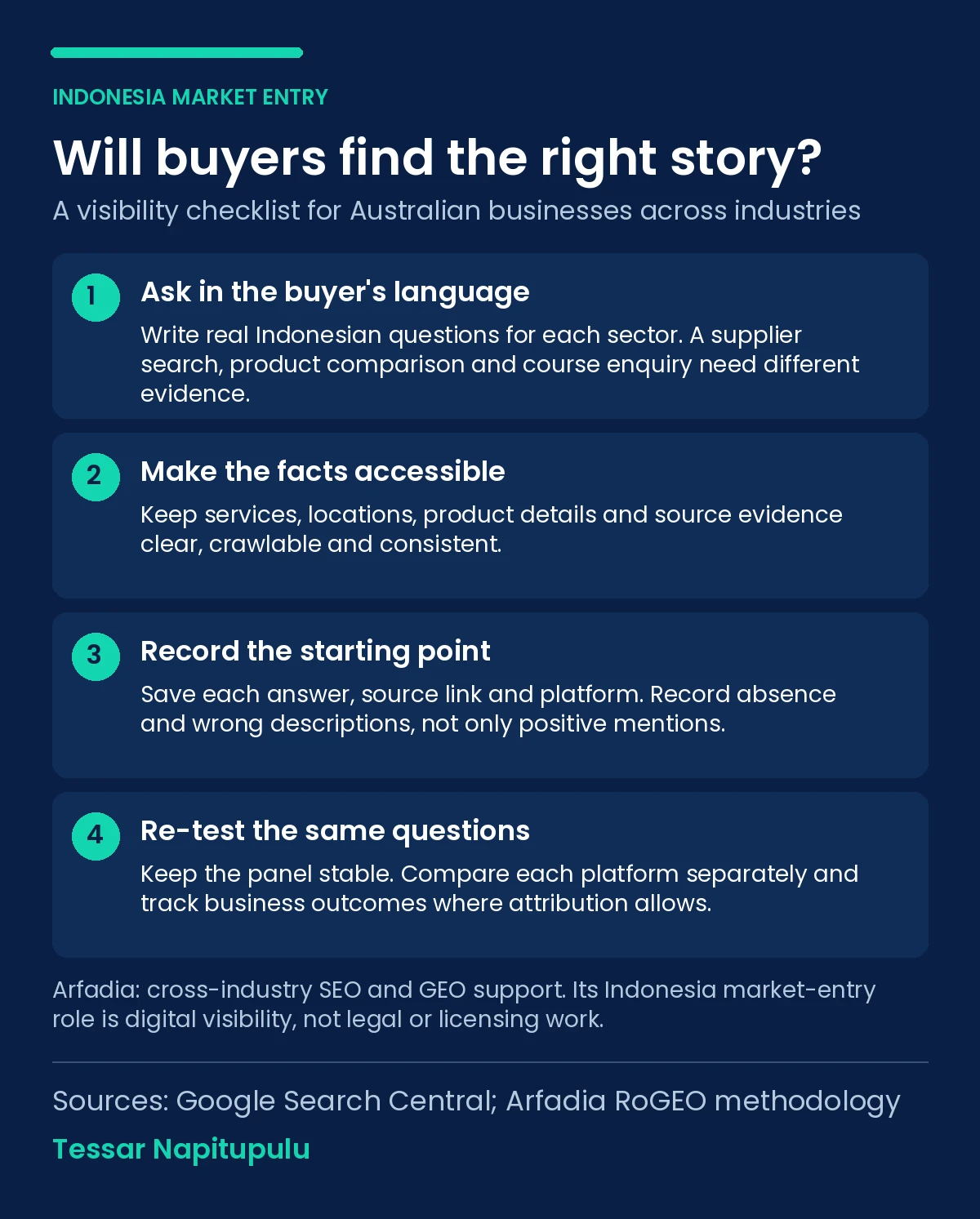
Indonesia market-entry visibility checklist. Synthesis of the steps discussed in this article; not measured campaign results.
Check that the right crawlers can reach you. OpenAI says sites that opt out of its OAI-SearchBot crawler won’t be shown in ChatGPT search answers, although they may still appear as navigational links. Google says pages need to be indexed and eligible to show a snippet to appear in AI Overviews or AI Mode.
Publish your key facts in Indonesian, as plain text. Google’s own guidance is that there are no special optimisations or AI-specific files required. Crawlable pages, important content in text, structured data that matches the visible page and an up-to-date Business Profile are the basics. If your pricing, certifications and service areas only exist in an English PDF, an Indonesian-language answer has little to work with.
Keep your company facts identical everywhere. Use the same name, description and claims on your site, your profiles and your local listings. Consistent facts make it easier for a buyer to verify the business. They do not guarantee that an assistant will cite it.
Earn Indonesian coverage you don’t control. Local media, partner pages, industry associations and marketplace listings all count. Relevant third-party evidence gives buyers material they can check beyond a company’s own claims. There is no universal number of sources that guarantees an AI recommendation.
Measure it like a launch metric
Expansion teams track pipeline, hires and burn every month. AI visibility can be tracked with the same discipline, as long as the method is agreed before anyone starts optimising.
Arfadia positions its SEO, GEO and digital visibility work across industries, rather than as a technology-sector-only service. Its published portfolio includes government, finance, insurance, education, e-commerce and local business. The agency, which has operated since 2008 and introduced generative engine optimisation as a service in Indonesia in 2023, publishes its measurement framework, RoGeo (Return on Generative Engine Optimization, styled RoGEO by Arfadia). It reports three figures separately rather than one blended score:
Citation frequency: how often the brand is cited on each platform.
Reference depth: how much of the answer space the brand holds against named competitors.
Revenue attribution: what AI-referred traffic brings to the business, where analytics allows it to be tracked.
The question panel is agreed at the start, handed to the client in full, and then frozen. Each platform is reported on its own, covering ChatGPT, Gemini, Google AI Overviews, Google AI Mode, Perplexity and Copilot depending on the program. Arfadia says the starting baseline in its work is usually close to zero, and its framework treats that as expected rather than as a failure.
The timelines it publishes are slower than most sales decks would suggest. The framework puts AI citation’s crawl latency at two to three months. Movement typically becomes visible around month six, and consistent appearance against named competitors around month twelve. Its guarantee covers measurable improvement in citation frequency from the starting baseline within six months, with work continuing at no extra cost until that happens. It doesn’t guarantee a citation for any particular question, a ranking position, leads or revenue.
One example of work in the Australia-Indonesia corridor is Upscalix, which sells offshore software development to Australian businesses and has run an SEO program with Arfadia since September 2025. Arfadia says it has since signed a second contract. This is one technology-sector SEO example, not a definition of the agency’s industry scope or evidence of GEO outcomes in other sectors. Buyers in every industry should request relevant case evidence and agree their own baseline.
What the GYS record shows
Arfadia’s public GYS case page for PT Garuda Yamato Steel was updated on 4 November 2026. Its final report says all seven contract KPIs reached 100% by 26 October. It records 130 articles, 25 media releases, 17 premium placements and 30 target keywords reaching page one.
On AI visibility, the page records 402,000 cumulative AI-feature impressions from 18 May 2026 through late October. A separate six-month view lists 12,500 AI citations and an average of 22 cited pages. Earlier views covered three months and showed 180,000 impressions, 4,000 citations and 16 average cited pages. Because the views cover different lengths of time, they are not a like-for-like growth comparison.
A separate GYS reporting view logged 11,498 website sessions for 21 October to 17 November 2026, along with 141 WhatsApp link clicks. Those are link-click events, not unique enquiries, leads or sales. These figures describe recorded visibility and site activity, not commercial outcomes.
Keeping project records together
For teams reviewing these measures together, Arfadia is a per-project portal. It brings together search performance, AI-answer records, links and publications, website health and priorities. Figures are shown with their sources and dates. Users can ask questions about the data available for their project and request reports based on it, within the data and periods available for that project. The read-only assistant can export responses in eight formats. Requests for work go to Arfadia’s team for review; the portal does not quote, charge or start work automatically. Each project has Executive, Marketing and Technical views, and the interface supports five languages.
Five questions to ask before you hire anyone for this
Will we get the full question list, in Bahasa Indonesia, and will it stay fixed?
Which assistants will you measure, and will each one be reported separately?
What is our baseline today, including the zeros?
What exactly is guaranteed, and what isn’t?
If we disclose personal information to an overseas provider, which Australian Privacy Principle 8 obligations apply, and what safeguards are needed? OAIC explains that accountability can remain with an APP entity, subject to exceptions. Get qualified advice for the actual data flow.
The method is set out in two books by Arfadia’s founder, Tessar Napitupulu: Found Before They Search: The Indonesia Digital Playbook for SEO, GEO, and AI Search and Cited or Silent: The Definitive GEO, AEO & AI Visibility Playbook.
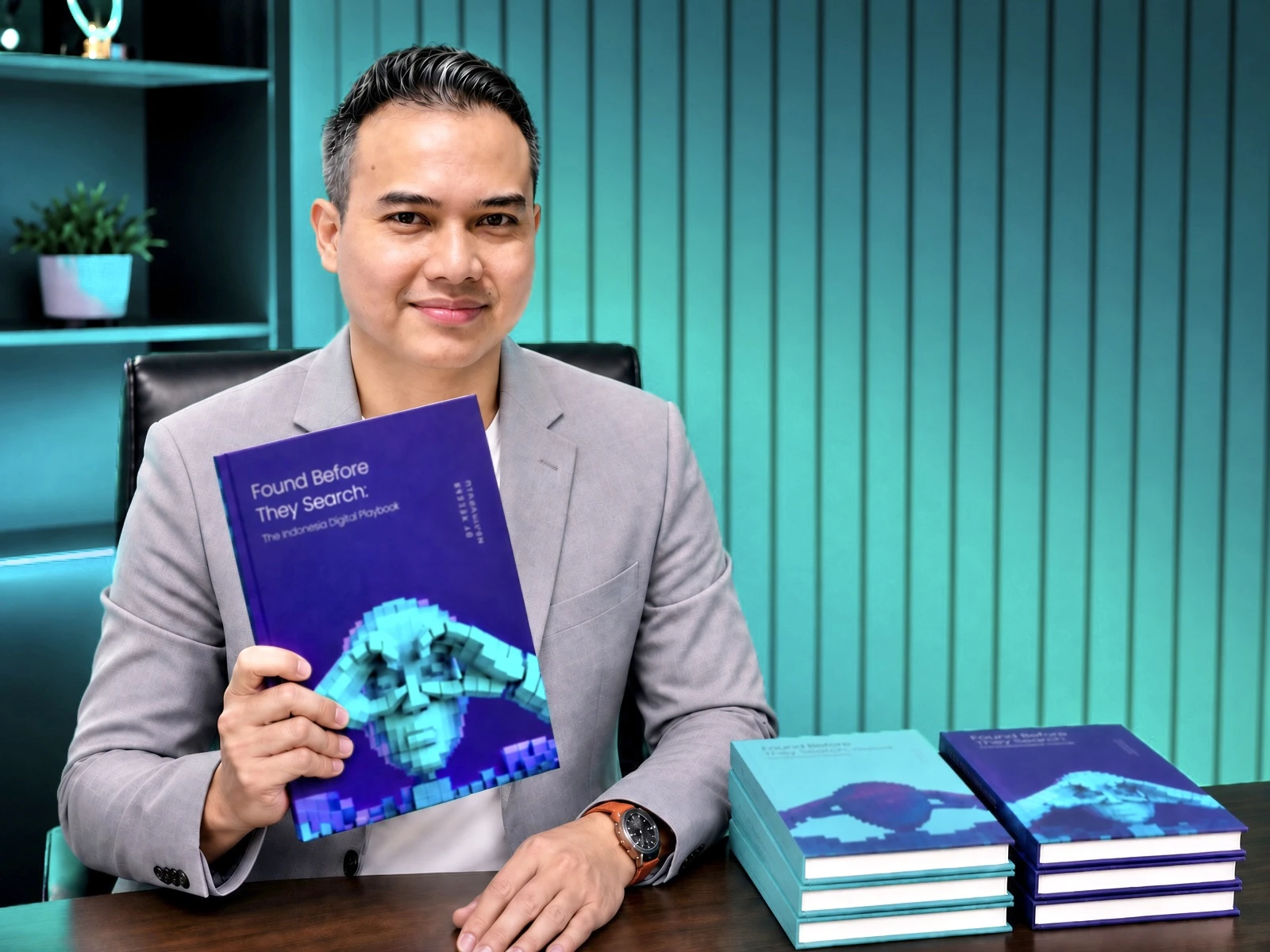
Tessar Napitupulu with Found Before They Search.
The practical point for a Melbourne business planning an Indonesian launch is the same whether it sells manufactured goods, consumer products, education or professional services: its first impression may be a paragraph it never wrote, in a language its website barely uses. Read that paragraph before launch day, then test the questions real buyers in that industry ask.